Why We Use a Different Standard for Body Composition
When clients ask about body composition testing, DEXA (dual-energy X-ray absorptiometry) often comes up as the familiar “gold standard.” It is widely used in research and clinical settings, and it does provide useful data on fat mass, lean mass, and bone density.
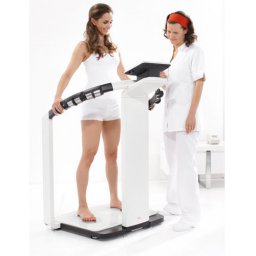
At BodymetRx, however, we use the SECA mBCA 554 — a medical-grade, multi-frequency bioelectrical impedance analyzer. The decision is based on how each method is validated, what it actually measures, and how practical it is for repeated tracking. Here’s a clear look at the differences.
What DEXA Measures (and What It Doesn’t)
DEXA uses low-dose X-rays to estimate body composition. It separates the body into fat, bone mineral, and everything else (often labeled “lean mass”). While this approach is well established, lean mass is not the same as skeletal muscle. It includes water, organs, and other non-muscle tissue.
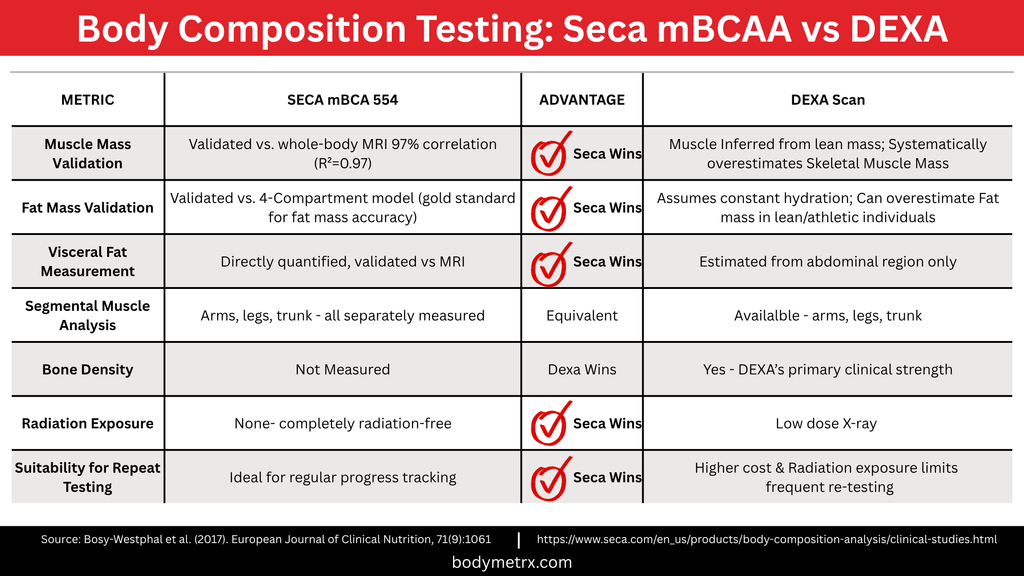
Because DEXA creates a two-dimensional image, it also has limited ability to distinguish true skeletal muscle from other lean tissue. Research comparing DEXA to whole-body MRI (the reference method for muscle) has shown that DEXA can overestimate skeletal muscle mass, especially as body size increases. It also does not fully account for individual differences in body water and mineral content, which can affect precision in leaner or more athletic individuals.
How the SECA mBCA 554 Is Validated
The SECA mBCA 554 uses an eight-electrode, phase-sensitive, multi-frequency bioelectrical impedance system. It sends safe, imperceptible electrical signals through the body and measures how different tissues respond. Those measurements are converted into results using equations that were developed and validated against higher-level reference methods:
- Skeletal muscle mass: Validated against whole-body MRI, with a correlation of 97% (R² = 0.97). Studies have shown that these MRI-based estimates of skeletal muscle are more accurate than those derived from DEXA.
- Fat mass / fat-free mass: Validated against the four-compartment (4C) model, which accounts for variations in water and mineral content — a more complete standard than DEXA alone. Correlation with the 4C model reaches 98%.
- Total body water: Validated against deuterium dilution (98% correlation).
These validations are published in peer-reviewed journals, including work by Bosy-Westphal and colleagues. Direct comparisons have also found that SECA’s fat mass estimates agree closely with DEXA without systematic bias.
Practical Differences That Matter for Clients
Beyond the validation data, several practical factors influence which method works best for ongoing health and fitness monitoring:
- No radiation: The SECA 554 uses bioelectrical impedance only. DEXA involves low-level ionizing radiation, which limits how often scans are recommended.
- Frequency of testing: Because there is no radiation exposure, the SECA can be used more frequently to track changes in muscle, fat, and hydration over time.
- Additional metrics: The SECA provides segmental skeletal muscle mass, phase angle (a marker of cell health), visceral fat estimates, and detailed hydration data that DEXA does not.
- Speed and accessibility: A full SECA assessment takes about 30 seconds of measurement time and can be performed in a standard clinical or wellness setting without the equipment and cost associated with DEXA.
The Bottom Line for BodymetRx Clients
DEXA remains a strong tool when the primary goal is bone density assessment or when it is used in a controlled research or medical context. For tracking skeletal muscle, body fat, and related health markers over time — especially without radiation exposure — the SECA mBCA 554 is grounded in more rigorous reference methods for the metrics that matter most to most of our clients.
At BodymetRx we chose the SECA 554 because the combination of MRI-validated muscle data, 4C-validated fat data, safety, and repeatability gives us (and our clients) reliable information for coaching, goal-setting, and progress monitoring.
If you’d like to see how your current body composition compares or how it changes with training and nutrition, a SECA assessment is a practical next step. Click here to book a scan!
References
- Bosy-Westphal, A., Jensen, B., Braun, W., Pourhassan, M., Gallagher, D., & Müller, M.J. (2017). Quantification of whole-body and segmental skeletal muscle mass using phase-sensitive 8-electrode medical bioelectrical impedance devices. European Journal of Clinical Nutrition, 71(9), 1061. PubMed
- Lahav, Y., et al. (2021). Comparison of body composition assessment across BMI categories by two multifrequency BIA devices and dual-energy X-ray absorptiometry. European Journal of Clinical Nutrition. PubMed
- seca. Clinical validation of body composition parameters (MRI, 4C model, and dilution methods). seca.com